‘Midnight and Blue’, by Ian Rankin
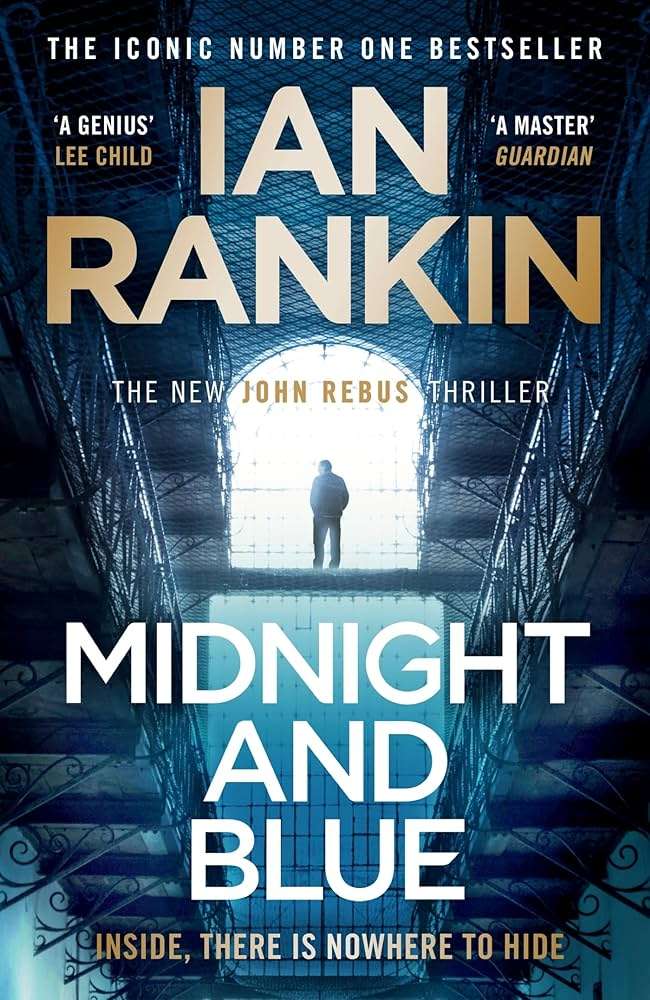
There are two certainties in literature and in life – the first is the perpetual presence of jazz in Ian Rankin’s work, and the second is ongoing marvel at just where John Rebus manages to find himself through his professional and personal escapades. Midnight and Blue is the twenty-fifth Rebus novel, and the series’ longevity and success is a testament to both Rankin’s excellent characterisation and and his refusal to resort to formula when approaching his writing. One suspects (and hopes) there are many more page-turners to come, with plenty of fire in the old detective yet.
For those needing a refresher, the twenty-fourth instalment, A Heart Full of Headstones, concluded with Rebus convicted of killing his erstwhile adversary Big Ger Cafferty and incarcerated in HMP Edinburgh (Saughton Prison). As many readers have come to expect, Rankin’s eye for detail and his ability to evoke a setting – whether a prison cell or a cityscape – are impeccable. The cells are rendered with an uncomfortable claustrophobia whilst the constant anticipation of violence stalks the halls and dining rooms, where restless men with time on their hands savour the prospect of causing danger for others.
This threat of violence is magnified for Rebus, given his proximity to individuals he has successfully put behind bars. It is this fundament upon which Rankin builds the new world into which we, as readers, are plunged, where danger is pervasive and immediate. Early on I wondered how Midnight and Blue would manage the transition from the open sprawl of Edinburgh society to the locked confines of Her Majesty’s Prison. Needless to say Rankin handles it with aplomb, crafting a double plot line – one inside and one outside the jail.
Rankin has noted that the ‘impossible murder’ at the heart of the plot stemmed from his own curiosity about the ‘locked room mystery’ that many novelists have attempted. By combining this with more conventional police procedural, he once again beguiles even the most engaged and attentive of readers, scattering breadcrumbs which ultimately lead to solutions deft and complex in both their execution and depiction.
Here, the impossible murder involves a locked cell, no identifiable weapon and a cell mate of the deceased who has been rendered unconscious by a heavy intake of the en vogue drug of choice, Spice. Rebus novels often feature such contemporary references, lending his scenarios a sense of immediacy, though in this instance he doesn’t incorporate any specific chronological framing device – such as a political event – seen in previous works. In the world beyond the prison’s four walls Edinburgh’s finest are hard at work, with Siobhan Clarke and Malcolm Fox (seen in The Complaints, and not the most liked of Rankin’s characters) investigating a case involving a missing schoolgirl, suspected child exploitation through the medium of online pornography. Once again, Rankin tips his hat to the current hot topics in policing and illegal activity.
A third strand of the novel follows ongoing conflicts in Edinburgh’s criminal underworld after the death of Ger Cafferty. As part of the succession process for the next kingpin, Cafferty’s absence has created a power vacuum and among those eyeing this opportunity is Darryl Christie, a psychopathic drug dealer whose influence has infiltrated the halls of HMP Edinburgh. Christie has benevolently (in the loosest sense of the word) offered to protect Rebus from danger in the halls and the leverage this offers him in terms of opportunities for carrying out his own activities has not gone unnoticed.
One notable aspect of Midnight and Blue is how prison life allows Rebus to observe inmates beyond those who operate in the serious crimes on which he works. This brings out a more reflective side to his personality, revealing a deeper understanding of the manifold reasons as to why an individual may commit a crime and the events underpinning that decision (reasons sometimes far more complex than mere choice). This broadened perspective of different prisoner types makes for both a fascinating character study and a sociopolitical undercurrent that enriches the detective work.
In short this feels as mature a work of Rankin’s as I have read to date and presents a different, less well-trodden path from other works. In a genre where routine and formula can often get the better of even the top writers, it’s a pleasure to say that Rankin is still pushing himself – and Rebus – into fresh, rewarding territory.
Midnight and Blue is published by Orion
(c) The Bottle Imp