‘The Absent Heart’, by Ali Bacon
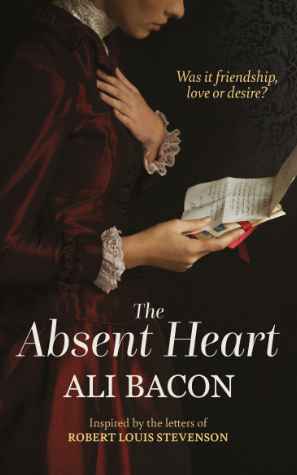
Ali Bacon is the author of three novels, two of them published by Linen Press. Writers like her, too easily labelled ‘independently published’, often suffer this kind of literary typecasting that downplays the scale of their achievements. In reality, she and other hard-working authors like her – invariably women – craft their books through years of research and labour into fine examples of the art of storytelling.
Bacon’s most recently published work, The Absent Heart (Linen, 2024), continues her exploration of historical subjects with the study of a little-known figure. Frances Sitwell’s role in the life of Robert Louis Stevenson has probably never been given the attention it deserves. Despite wide interest in his work following his early death, Stevenson’s papers were tightly controlled by his editor, Sidney Colvin – Sitwell’s husband. As a result, her role in the author’s life, recorded in letters between them up until his death, was mostly excluded from Stevenson’s story. Colvin’s motives are intriguing: he may have felt the correspondence too revealing of his wife’s friendship, or perhaps the letters held details he did not wish to share. Whatever the reason, in this portrait of Sitwell’s life and times Bacon restores – as far as is possible – this unjustly ignored character to her rightful place as Stevenson’s confidante, friend and, perhaps, lover.
The story of Sitwell and Stevenson’s correspondence is complex. While Sitwell kept all of Stevenson’s letters, he appears to have honoured her request to ‘burn them after you get them’. ‘The problem was there wasn’t really a lot of go on,’ Bacon says. ‘Her letters were all destroyed and there are only snippets of other things surviving … I did a lot of burrowing into other people’s footnotes…’. Bacon’s aim, however, is not simply to reproduce historical events. Her second novel, In the Blink of an Eye (Linen, 2018), which centres on the joint work of the artist David Octavius Hill and the photographer Robert Adamson, is a ‘re-imagining’ rather than a faithful account, as is The Absent Heart. But Bacon has also taken care to ensure that all the turning points and characters in her story of Sitwell’s friendships – including Fanny Osbourne, the Gosses, Edward Burne-Jones and others in Stevenson’s circle – are historical. Her interest, however, seems less in what happened among these groups than how they affected Sitwell’s decisions about her life. In The Absent Heart, Frances seems to defer to her husband’s decision to exclude much of the Stevenson–Sitwell correspondence from his edition of the author’s Letters. But later, in real life, she bequeathed all of Stevenson’s letters, via Colvin, to the National Library of Scotland, with a twenty-five-year embargo on their contents. So complex are the implications of this act that Bacon chose to compose for The Absent Heart letters from Frances to Louis – an imaginative leap justified, she argues, by the fact that the pair corresponded up until Stevenson’s death. ‘It was a genuine friendship… she didn’t just disappear out of his life,’ Bacon says.
The validity of this approach in a historical work will no doubt be part of future discussions, but Bacon has never claimed to be doing anything other than writing her own brand of fiction. What deserves equal attention is how successfully Bacon succeeds at portraying the constraints and possibilities of women’s lives in their times, in ways that feel familiar even today. In Sitwell’s world, the tug and pull of family, convention, husbands, divorces, children, friendships, love affairs – desired or enacted – and the need for respectability form the edges of what is possible. Exploring the complexity of this under the surface seems Bacon’s intention, and, although accuracy remains important, this focus on the inner drives of her characters does much more than bring historical characters to life. What Bacon shows in her women, time and again, is their determination to lead the lives they choose without causing discomfort (or no more than necessary) to others. In her fiction, we meet older women, unmarried girls, young brides trying for a baby, adolescent girls negotiating first desires, widows seeking new partners, unhappy wives contemplating divorce – and all plan their ways carefully. Whilst unable in a strait-laced society to overthrow custom, they can still change things here and there in their lives. A young woman stops herself laughing out loud, since ‘full-blown laughter is not ladylike.’ In A Kettle of Fish (Thornberry, 2009), Bacon’s first novel, teenager Ailsa is kissed by the fishmonger’s son and later imagines him putting his hand somewhere ‘lower, warmer’ – while thinking of another boy’s ‘nice tight arse’ at the same moment. Women’s moments of happiness or pleasure are carefully guarded secrets, but in these hidden bursts of desire they explore what they want and sometimes win it.
This can most certainly be said of Frances Sitwell, who in The Absent Heart emerges from her sea of troubles quietly victorious. The real Frances Sitwell is known to have been extremely happy in later life and we can thank Ali Bacon for demystifying and celebrating the path she took to get there.
The Absent Heart is published by Linen Press
(c) The Bottle Imp