Witch Wood, Buchan’s favourite of all his novels, is set in the seventeenth century, a world where the two bastions of medieval Europe, the Holy Roman Empire and the Papacy, had given way to a fracturing of power. Eminent nation states, their ambitious rulers, and fierce religious dissension, led Central European countries to a grim, unrelenting theatre of war that lasted from 1618 to 1648. Known as the Thirty Years War, this conflict reconfigured the balance of power in favour of France and Sweden, with millions of soldiers and civilians killed as a result of fighting or its attendant plagues and famines. Between 1639 and 1653, England, Scotland and Ireland were locked in their own intricate sequence of conflicts, the Wars of the Three Kingdoms. This began with the First Bishops War of June 1639 and continued until Cromwell became Lord Protector of the Three Kingdoms in 1653. These hostilities revealed a tenacious, powerful Scottish Kirk that was not content to become an extension of Charles I’s Anglican Church. The more the secular world appeared vulnerable and unsettled, the more intense and imperious the different beliefs that evolved to take the place of Papists and Empire.
After the break with Rome, it was unclear until 1690 whether the Presbyterian or Episcopalian Church would be validated through constitutional act as the official religion of Scotland. Witch Wood challenges what it was to be Scottish in terms of national politics and religious identity during the Wars of the Three Kingdoms, and engages with a modern revisionism wherein the extremes of King and Covenant, Cavalier and Covenanter, Kirk elder and sinner, blur to become more complex and conflicted. In July 1637, Charles I, eager to standardise religious practice across his lands, imposed a Laudian edition of the book of prayer in Scotland. Popular opposition followed and Scotland’s defiance was formalised when the Earl of Rothes and James Graham of Montrose led the signing of the National Covenant in Grey Friar’s Churchyard, Edinburgh. A dozen copies were sent to additional towns. Those who signed undertook to protect Scotland’s Presbyterian religion from incursions by King or Anglican church. Seventeenth-century Kirk ministers envisaged a state that would bring England under its own religious practices, as civil and ecclesiastical authority seemed to merge, and self-interest shaped many individual and collective interventions in the world of politics, parish and military action.
Witch Wood’s first chapter opens in Woodilee, a quiet rural parish in the Scottish Borders, a retreat that Buchan based on Broughton, the home of his maternal grandparents and aunt, and one of the first places to inspire his enduring love of nature and the Scottish landscape. Boyish and newly ordained, David Sempill is a Presbyterian minister taking delight in his new home and the prospect of serene hours spent in scholarship, tending to his parishioners and revisiting childhood haunts. Woodilee lies far from the battlefields in Europe. It is cocooned by gentle hills and the forbidding Melanudrigill, the dark Wood of Caledon. With the exception of David visiting a dying father, and the trade of Andrew Shillinglaw, the farmer of Reiverslaw, neither David’s congregation nor the reader will leave the Presbytery lands until the epilogue.
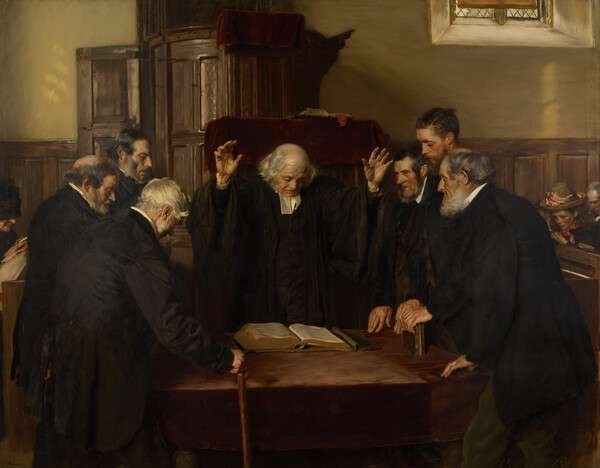
This article examines why, in such a secluded, blinkered Scottish community, a coven has established itself, and why, at the close of the novel, an eident, resourceful minister finds himself isolated, excommunicated and departing Scotland to take up arms in Europe. All answers must begin with the Presbyterian Church that David serves, a faith that evolved from Calvinism with its belief in predestination and a structuring of time in which past, present and future are enfolded within one another. Calvinism states that God alone can offer salvation through his generous gift of grace, and mortals cannot hope to attain this through their own endeavours. The Calvinist structuring of the temporal world means that God knows whether a mortal will be saved or damned before they are born. The descent into a nature deprived of grace haunts the novel, as those who find themselves trapped in a world of profane matter look elsewhere for inspiration. Buchan sets his novel at a point in time during the seventeenth century when many in the Kirk had arrogated to themselves the ability to discern who would be saved as God’s ‘elect’ and who would suffer damnation.
The Kirk’s austere interpretation of the primacy of God’s grace over a covenant of works is made clear when David and the gentle minister James Fordyce ride away from Kirk Aller. They encounter the minister of Bold, Mr Proudfoot, who wastes no time in challenging David: ‘It is reported that you pervert the doctrine of election into grace, maintaining that this blessed state may be forfeit by a failure in good works.’1 David’s response is that any man who believes he has secured salvation and can therefore sin with impunity is ‘more doubly damned than a man who has never had a glimpse of grace’. The subtleties of Mr Proudfoot’s pontificating on the privileges of the elect are then lost as his tongue and his horse run away with him. Only later in the novel do the dangers of this conceit and sense of entitlement become clear.
If the modern reader often feels overwhelmed by biblical references and the intractable kirk elders, this can only underline the plight of Woodilee and other rural parishes as a vengeful Old Testament God, conjured in their weekly sermons, appeared to preside over an endless sequence of prohibitions, hardships, punishments and terrors. Where communities do meet in the novel, folklore and traditions appear somehow blighted. Not long after his arrival, David glimpses Halloween celebrations but finds that, unlike the other ministers, he cannot ‘condemn the ancient fashions’ (p. 50). In the days that follow, the men and women look pale and drawn, as if the festivities had strained body and soul. Oppressive Presbyterian discipline censured or forbade many of the customary, popular celebrations such as guises, folk dances, ballad singing, Scottish penny bridals, and the dressing of wells and springs with intricate floral arrangements. Katrine, the young woman David falls in love with, gestures towards this innocent nature worship with her ballads and her gathering of primroses at the spring in ‘paradise’, a part of the wood away from Melanudrigill’s sinister pines. Both Reiverslaw and James Fordyce sense that if the church stifles these simple, secular pleasures then the parish will drift towards more arcane distractions.
Woodilee may have taken its first steps towards the occult precisely because of the Kirk’s exclusive interpretation of salvation. For moribund existences who understand themselves to fall outside the consolations of the elect, the role of buidseach or bana-bhuidseach (male of female witch) may have held few fears. Scottish witchcraft appeared far more preoccupied with the demonic or diabolic pact than its English counterparts. Souls were exchanged for revenge, fame, privilege, good fortune, fertility, knowledge, enchantments and heightened experiences. On Beltane’s Eve or Rood-Mass, David enters Melanudrigill, despite the warnings of Daft Gibbie and the manse housekeeper, Isobel. In a glade with a pagan altar at its centre, he encounters the coven’s ‘white tranced female faces, the obscene postures’ of frank sensuality, the half-naked women and the men in animal masks performing their eldritch widdershins, and the King-Devil himself, a shrill piper, ‘a gaping black hound’ (p. 82). David attacks the piper, catching a glimpse of his red hair just before the coven overwhelm him, and he is transported, unconscious, back to the manse.
In the first chapter it is the minister Mungo Muirhead’s proud boast that there have been more individuals in Woodilee informing against witches than in any other parish on the Water of Aller. In 1563 ‘An Act Against Conjuration, Inchantments and Witchcrafts’ established black magic as both heresy and a secular capital crime. The Act was not repealed until 1736, with Scotland hosting many more trials than elsewhere in Europe. In rural areas the Kirk and its elders presided over the trials, and here execution rates were much higher than with the Court Judiciary in Edinburgh. The reader is therefore baffled as to why the villagers will do anything, including locking David in his study overnight, to avoid challenging the coven and disturbing its rituals in Melanudrigill. Eventually, Reiverslaw and David do succeed in identifying Ephraim Caird, ‘Chasehope’, as the coven leader. Dressed in deerskins with an antlered mask, Reiverslaw moves among the dancers during the July Lammas Eve Sabbat and throws aniseed oil at their leader, whilst David watches from the branches of a tall pine. Reiverslaw arrives at Chasehope’s farm the next morning to find Caird’s wife, a meek cypher of womanhood, burning the pelts that reek of aniseed, and ready to lie to hide her husband’s whereabouts. The necromancers are also protected by the dark pines themselves. As with the oak grove at Loch Saint, Skye, or the ancient hazel groves outside Edinburgh, no person would venture into Melanudrigill to cut or collect wood out of superstitious fear or veneration.
The Scottish church was progressive in replacing the esoteric Latin of Catholic piety and the elaborate liturgy of Arminianism with language that embraced the demotic register. Ministers could address the concerns of their congregation and apply this to extemporised prayer and their own analysis of Scripture. Congregations, however, remained vulnerable through a lack of education. The Scottish countryside in the early 1640s relied on local ministers to set up parish schools of the kind David begins at the manse, but rural literacy levels remained very low. Out of three hundred communicants, David doubts that more than a dozen could read or write their own names. This reliance on the improvised spoken word and the interpretations of those in positions of authority, offers the predatory Chasehope a peculiarly malleable and naïve community for whom invocations, simple rituals, dances and sensuality would have an immediate appeal. Chasehope also enjoys the privileged position of Ruling Elder, a respected role that he has already held for ten years. The elders and the ministers together form the Presbytery, with the formers’ responsibilities including pastoral care and spiritual guidance. This places Caird in a position of trust and influence, and the suggestion is that he uses this authority to recruit and reward coven members – notably the slatternly widow Jean Morison and her daughter. He is adamant these two women should receive funds from the meagre church Poor Box despite wanting for nothing in their home. David’s refusal provokes an early glimpse of Chasehope’s spite at having his control challenged: ‘the greenish eyes looked for a moment as ugly as a snarling dogs’ (p. 56).
David’s parish is never further from him than when he moves among them, putting his own life at risk, tending to their spiritual wellbeing and their physical comfort and safety during the plague. The villagers prove perverse in their prejudices, their ingratitude and their blind superstitions. There are no young men with whom David can share his concerns or find friendship, and even the warlocks of the coven remain faceless and nameless behind their masks beyond the final pages of the novel. The young women of the parish are blighted, and there are worrying numbers of stillborn children. The mothers of these children sit, scorned and alone, on the stool of repentance in the Kirk, without the support of the men who have sinned with them, men who are remarkable in their cowardice. The gentle, far-sighted James Fordyce may speak up for David and Katrine during the Presbytery trial, but he is often overwhelmed with illness and a desire to remain a loyal, conciliatory servant of the church.
In Witch Wood, the Scottish Church looks for the devil everywhere but amongst its own. The image of Satan bleeds into the Kirk’s representations of its enemies, notably Catholics, or Montrose and his armies, who are fighting for the King against a church that they understand to meddle ‘arrogantly in civil matters’ (p. 40). The Presbytery delivers its sermons, prayers, propaganda, and even messages from the Covenanting wars, using demonising rhetoric that the parish unthinkingly mimics – Montrose’s men become ‘malignants’ and their leader ‘yon whelp of Satan’ (p. 142). During the seventeenth century, elves and fairies also slid irredeemably from the gentle world of folklore to the devil’s retinue, with these bogles and spirits often cited as fellow conspirators in witch trials. Katrine Yester, despite her gracious ministering to the poor during the plague, compounds Davids’ troubles with the parish and the Kirk as her ‘papish’ origins and her ethereal beauty excite awe or horror, and she becomes ‘the Queen of Elfhame’.
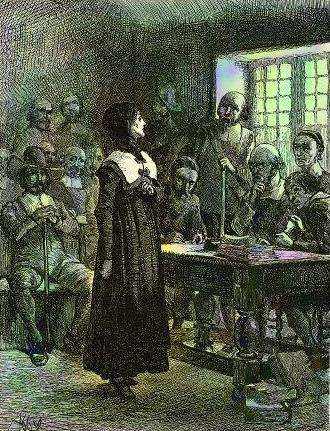
As Buchan was writing, he would have been aware of the meticulously documented Massachusetts Antinomian Controversy of 1636–38. Antinomianism is a conviction, held in the context of religion or philosophy, that an elect individual transcends laws, rules or moral imperatives. Taking place just a few years before David arrives in the parish of Woodilee, the New England episode set the Puritan ministers of Massachusetts Bay against a young magistrate, Henry Vane, a minister, John Cotton, and a defiant but eloquent woman, Anne Hutchinson. At meetings called conventicles, Hutchinson began to preach the futility of good deeds or a covenant of works, and she came to exercise great influence.2 The historical narrative would have revealed to Buchan the subtleties and extremes of an overdetermined interpretation of the primacy of grace over human endeavour and benevolence. Hutchinson shares Chasehope’s sense of herself as a privileged voice of divine revelation, predicting calamities for the colony that defied her, much as Caird threatens David with prophecies of more death and sacrifices to come as the plague abates. Chasehope and Hutchinson cite intimate communication with a God of retribution whose ‘judgements are not exhausted’ (Witch Wood, p. 240), a piety that appears to preclude obedience to scripture and the possibility of admonition. Whilst Hutchinson is banished from the colony, Chasehope’s fate is more sinister and ambiguous.
The accusations that David levels at Chasehope and the coven are dismissed by the Kirk, and to further divert attention from himself, Caird summons a witch-pricker to question and torture the elderly, ‘half-witted’ coven member Bessie Todd, knowing she lacks the ability to defend herself (p. 200). David returns to Woodilee too late to save Bessie’s life, but manages to take her away from Chasehope and the witch-pricker so that she can die peacefully in the manse. When in April, David is summoned to his very public Presbytery trial, he is excommunicated for helping the injured Mark Kerr, a colonel of Montrose’s armies, for consorting in the dark woods with a woman (Katrine Yester) and burning the infected houses of the parishioners to try to stop the spread of the plague. David is humiliated and punished for choosing the path of humanity over the bitter jeremiads and partisan cruelties of his church ministers.
The final pages of the novel allow for David to be snatched away by the Devil or the fairies, acknowledging the children’s storytelling in the prologue. Buchan also creates an alternative departure, David setting sail with Mark Kerr for the European Wars as a wider stage on which to defend the Protestant faith. As early as chapter three we learn that Nicholas Hawkshaw, the laird of Calidon Tower, Will Rollo and Mark Kerr, have all returned from serving with the Swedish armies, as have many of their opponents in the Covenanting army. Sweden’s King, Gustavus Adolphus, entered the Thirty Years’ War intent on territorial expansion and defeating the Catholic Hapsburg’s dominance in Germany. His powerful personality and tactical innovations changed the course of the war, and the fortunes of German Protestant Princes, securing their freedom from the Holy Roman Empire. However inspirational their leader, even Gustavus’s strategically brilliant Swedish troops could not fight with the country’s standing armies and conscripts alone. Soldiers of fortune formed the bedrock of all of Europe’s armies. Gustavus’s main campaign between 1630 and 1632 was particularly reliant on Scottish ‘waged men of war’, with around fifty thousand Scots fighting for the Protestant cause. Sweden continued to recruit Scots soldiers long after Gustavus’ death.
Seventeenth-century Scotland was a land of hardship and few opportunities, where a fierce uncompromising appetite for change often fostered violence. Many Scotsmen left for the Thirty Years War, some returned to fight in the Wars of the Three Kingdoms, and then rejoined European armies, as the Treaty of Westphalia was not until 1648. For privileged Scottish nobles, Europe afforded influence, patronage, military prestige and leadership, and many took with them armed men who were already in their own service. A culture of allegiance to their native captain or general, waged employment, honour, religious convictions and comradeship kept Scottish warriors loyal to the officers and men with whom they had emigrated. So, David is not alone in choosing to leave for battle. He has learned swordsmanship before being ordained as a minister, and he has always relished Woodilee’s harsh climate, difficult terrain and the sheer physical discipline and endurance that make his life like that of a soldier. Brotherhood, friendships, camaraderie, and an inspirational leader, are also missing from David’s life until he encounters James Graham of Montrose and his companions at Calidon Tower.
James Graham was King Charles’s Lieutenant General in Scotland, and his dedication and tactical brilliance in 1644 led him to the title Marquess of Montrose. As soon as David listens to Montrose speaking about his loyalty to the King over Church and Covenant, he senses his own doubts and his own desire to engage at a practical, didactic level with his parish, leaving complacency and dogma to the older ministers. Montrose was against men like Archibald Campbell, the Marquess of Argyll, whose statesmanship seemed selfish and strategic. Graham also challenged a Kirk that wanted to rule over both civil and spiritual matters. David listens attentively to Montrose’s ideas but is beguiled more by the Marquess’s force of character. The young minister’s thoughts attest to the real Montrose’s ability to inspire any amount of loyalty and courage, a kind of enchantment cast over the men he wished to influence in any number of trying circumstances. This spell enabled him to hold together improvised bands of soldiers, often untrained, volatile men with conflicting religious and national convictions, and with breathtaking speed and tactical brilliance to defeat the Covenanters in battles such as those at Tippermuir, Inverlochy and Aberdeen. He led the savage Irish Macdonalds and headstrong Catholic Highlanders alongside Calvinist Stewarts, Robertsons and other Presbyterians, all without dissent, and often without pay. They drew their enemies through perilous mountainous regions and Caledonian forests, to outwit the Covenanter armies time and time again until the Battle of Philiphaugh in September 1645.
As to the coven’s leader, Buchan gives us Daft Gibbie’s elliptical retelling of the apparition that was once Ephraim Caird, wolf-like, ‘rivin a yowe’ (tearing apart a ewe) on the hillside, for all the world shape shifting like a creature from the Norse mythologies that form part of Scottish heritage. The reader will never know who the masked warlocks of the coven are, and whether other Presbytery members are involved. We note the tears and anxiety of Reiverslaw and Amos Ritchie at the loss of their devoted minister and wonder what will become of a parish with nobody to challenge either necromancers or vindictive Kirk members. We are never sure how much of Melanudrigill’s power is attributable to the Black Sabbats and how much belongs to afterimages and echoes from less iniquitous Celtic and pagan rituals witnessed by the leaden pines earlier in the Great Wood of Calidon’s history. David listens to Montrose’s critique of a Church that would set itself above the crown, and finds he feels no affinity with the complacent ministers of Kirk Aller and Bold, concluding that true humanity is better embodied in the humble, shepherd at Greenshiel. In Buchan’s story of Montrose, Covenant and Kirk, Scotland and its elders have strayed far from the Covenant of 1638. It is a tale that demands to be read again at a time when paganism has become Scotland’s fastest growing religion, and beliefs that venerate ancient clan cultures, animism, the sacred groves of the Celts, the rites of Beltane, Samhain, Lughnasadh and Ostara, and the formidable powers of earth and nature, are once again coming to the fore.

