Living in the City – or not: Urban Scotland in Scottish Children’s and Young Adult fiction
The picture of Scottish urban literature for adults is presented as one of gritty hyper-reality examining working-class life, industrial decline and the dark underbelly of cities like Glasgow and Edinburgh. It shuns romanticised, pastoral portrayals of Scotland and tends towards the use of authentic Scots language in various dialects. The picture of urban literature for Scottish children and young adults presents a slightly modified picture.
Scottish children’s and young adult literature has a strong track record in producing historical and fantasy fiction but, particularly post-1945, there has been a huge growth in what might be called realistic fiction, at least some of which takes place in cities. Realistic fiction deals with the problems children and young people face at a time of physical, psychological, intellectual and emotional maturation. Scots writers excel in this area as shown in these novels, among others: A Sound of Chariots (Hunter, 1973); the ‘Kevin and Sadie’ novels of the 1970s (Lingard, 1970–76); Fat Boy Swim (Forde, 2003), Skarrs (Forde, 2004) and The Drowning Pond (Forde, 2005); Theresa Breslin’s Simon’s Challenge (1988), Whispers in the Graveyard (1994, Carnegie Medal Winner), Saskia’s Journey (2004) and Divided City (2005); Julie Bertagna’s The Spark Gap (1996) and Soundtrack (1999), and Catherine MacPhail’s Run, Zan, Run and Roxy’s Baby (2005). These books deal with issues from bullying to sectarianism, body image to ecological disaster. Their settings range from the completely urban to the rural Highlands and all points in between and include passionate political statements and compassionate descriptions of contemporary Scottish children’s lives. They offer a blend of contemporary realism and deeply rooted myth and legend while displaying an awareness of generational differences as well as a keen sense of history. Language shifts between Standard Scots English and colloquial, dialectal slang. Modern children’s and young adult literature, in the realistic genre, has been quick to reflect all manner of social change. It contributes to the development of children’s understanding of belonging (being one of us) and differentiation (being other). The constantly shifting socio-cultural landscape has contributed to the blurring of traditional distinctions between, for example, the urban and the rural, the island or the mainland. Children’s literature offers a way of presenting identity simplified and distilled, mediated by the needs and expectations of its audience. As a result, the presentation of urban Scotland can appear as contemporary realistic fiction or futuristic dystopian fiction in settings like housing schemes and underground cities in a more fluid way than for adult readers.
Tracing the development of urban Scotland through the work of some specific writers offers a view of the range of subject matter and perspectives addressed in their work.
Theresa Breslin is a Carnegie Award-winning author whose first book, Simon’s Challenge (1988), was written when she was working as a mobile librarian. Her route included a small village where a major steel mill closed down resulting in widespread unemployment in an already fairly deprived area. This book mirrors the circumstances of Scotland in the late twentieth century and examines the consequences for the community, particularly families and children, as a result of the drastic economic consequences. Told through the eyes of the protagonist Simon, the book examines the helplessness of children being affected by the decisions adults make. The context is specific, the outcome highly relatable.
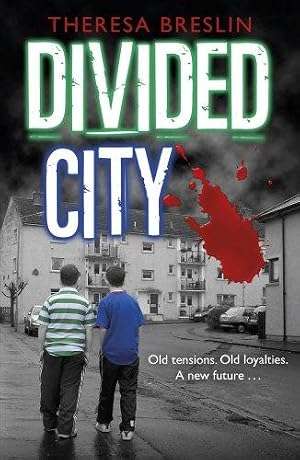
In contrast, Breslin’s Divided City (2005) was an ambitious project, intended to explore a specific topic – the sectarian challenges of football in the city of Glasgow. Always a sensitive topic, the book attempts to articulate both the challenges and similarities between the partisan supporters. The novel opens with Graham, a devoted Rangers supporter, witnessing a violent assault while walking home from football training. This incident serves as the catalyst for a narrative that examines sectarian divisions in contemporary Glasgow, particularly those associated with Protestant and Catholic football allegiances. Alongside this exploration of longstanding social tensions, the novel addresses the experiences of asylum seekers attempting to build lives within the city. Through the perspectives of its young protagonists, readers gain an increasing awareness of the challenges and prejudice faced by many displaced people. The text also highlights the effects of poverty and social inequality, suggesting that economic deprivation can be as significant a source of division as religious difference. As Graham’s father puts it, ‘deprivation, and all that goes with it, is what really divides a city’. Divided City tackles religious and social bigotry in present day Glasgow and encourages young readers to reflect on issues of identity, belonging and social justice.
A later novel of Breslin’s, Caged (2016), is a tale of teenage cage fighters living in London’s subterranean tunnels. At first sight it appears to be another slice of the dystopia that has dominated fiction for teens and young adults in recent times. In Caged a group of homeless young people seek refuge in the London Underground’s disused tunnels. Led by a former boxer, they attempt to raise money by staging live tournaments which are broadcast on YouTube. Breslin’s novel is far from dystopian or futuristic. The Carnegie-winner wanted to write something that was ‘conceivable’, ‘that could happen’ and that would draw attention to rising teen homelessness, as well as the way young people can so easily slip between the cracks. Caged, therefore, is set in contemporary times. It’s an Oliver Twist for today. Breslin’s thought-provoking novel makes the point that she was not creating a dystopia because she wanted readers to understand this was not fantasy, not science fiction not The Hunger Games, which is one step removed.
Another writer whose work sits comfortably under the urban Scotland umbrella is Cathy MacPhail, the Greenock author who often uses housing schemes as a setting to tackle issues from bullying to unwanted pregnancies to the problems of managing debt to encountering former child soldiers among newly arrived asylum seekers. MacPhail’s first novel Run, Zan, Run (1994) deals with a social issue, bullying in this instance, embedded in a thriller. Katie is the only child of loving, comfortably off parents, but this perfect life is marred by bullies. In Run Zan Run, Katie is attacked while walking home from school but is rescued by a mysterious girl whom she later nicknames ‘Zan’, after the box in which she lives. As the narrative develops, it becomes clear that Zan is hiding from circumstances that are gradually disclosed and ultimately explained at the novel’s conclusion. Living in abandoned buildings and neglected urban spaces, she has developed a strong sense of independence and self-reliance, qualities that she encourages Katie to cultivate in herself.
The novel centres on the experiences of young people subjected to bullying and is firmly aligned with the perspective of its victims. Through Katie’s reflections, the text questions approaches that focus primarily on explaining or contextualising the behaviour of bullies, highlighting instead the ongoing impact of intimidation on those targeted by it. The novel also draws attention to the ways bullying can extend beyond the school environment, persisting in public spaces and on journeys to and from school. While these social issues form an important part of the narrative, they are embedded within a fast-paced thriller plot that is likely to engage readers through its suspense and action. Although the novel’s conclusion relies on some highly dramatic developments, Run Zan Run nevertheless offers a compelling exploration of resilience and personal empowerment within an urban setting.
MacPhail’s next book was also set in a tower block. In Fighting Back (1998), Kerry and her mother move to a council estate after the breakdown of their family circumstances. Their arrival quickly brings them into conflict with Ma Lafferty, a local moneylender whose influence extends across the estate through networks of debt and intimidation. When Kerry’s mother reports a member of the Lafferty family to the police, she and Kerry become the targets of escalating harassment and threats. As the situation deteriorates, culminating in an attack on their home, Kerry recognises the need to challenge the climate of fear that has allowed the Laffertys to dominate the community.
The novel explores the social consequences of poverty and informal systems of power within disadvantaged urban environments. At the same time, it examines themes of resilience and collective action, as Kerry and her mother discover sources of support among their neighbours. Through its portrayal of life on a contemporary housing estate, Fighting Back engages with issues of social exclusion and community dynamics while presenting a narrative of resistance in the face of intimidation.
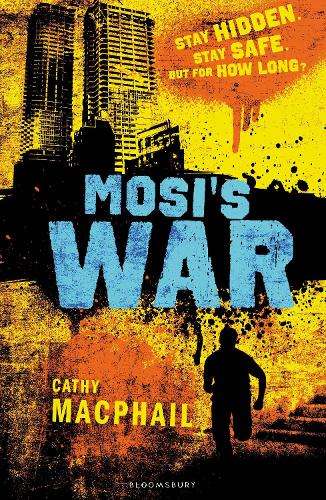
MacPhail’s later work Mosi’s War (2013) continues to use the urban setting to explore relevant issues but tackling even more challenging issues in a more nuanced way. Mosi and his parents are asylum seekers in Glasgow, fleeing from war-torn Somalia, and he slowly develops a friendship with a Glaswegian, Patrick Cleary. When Mosi inadvertently stumbles across notorious war criminal Papa Blood, who is clandestinely evading capture by living as an asylum seeker in Glasgow under a stolen identity, it transpires that he was a child soldier enslaved by Blood’s malevolent regiment. The novel’s opening sees Patrick witness an asylum seeker’s suicide, only to realise later it was a murder by Blood, and this awakening brings the warlord to Patrick’s flat to kill him, ensuring his ultimate silence to avoid capture. Patrick is saved by Mosi, who realises Blood’s intention, so cementing a friendship between these boys which, in turn, advocates the need for alliance rather than alienation between different cultures living within the same city. This novel is a subtle shift in sophistication in MacPhail’s work as she leans in to the growing body of young adult literature where Scotland’s future generation increasingly sees itself reflected in textual narratives that advocate a voice for those hitherto marginalised within literature and culture. Integral to a new vision for Scotland is, of course, its future generation and how they can be encouraged to participate in shaping its trajectory in a global world of transnationalism, climate change, conflict, and post- secularism. MacPhail’s Mosi’s War, like Theresa Breslin’s Divided City, directly responds to the demands of globalisation by featuring asylum seekers, particularly the boy mentioned in the title.
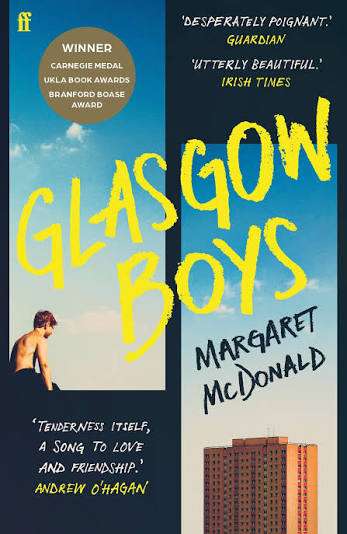
An exciting new voice in urban literature for young adults is Margaret McDonald who won the Carnegie medal in 2025 for her novel Glasgow Boys (2024). The novel centres on two teenagers, Finlay and Banjo, as they make the transition from the care system into early adulthood. Although their lives have followed very different trajectories, both must negotiate the practical and emotional challenges associated with leaving care, including questions of belonging, self-worth and future aspirations. Finlay is studying nursing at university, while Banjo is attempting to adjust to a new foster placement and complete his secondary education. By bringing together two characters from contrasting backgrounds and circumstances, McDonald explores the varied experiences of young people in care and the connections that can emerge between them.
A key concern of the novel is the significance of relationships that exist beyond conventional family structures. As McDonald has observed, ‘To me, Glasgow Boys is about unconventional forms of love, platonic and romantic. Banjo and Finlay have a real kinship, like platonic soulmates, and it felt very important that they were really different and came from different backgrounds.’ Themes of mutual support and emotional intimacy are therefore central to the narrative, alongside an examination of masculinity, class and identity in contemporary Scotland. The text also engages with public perceptions of the care system, inviting readers to consider the barriers and opportunities encountered by care-experienced young people. McDonald has expressed the hope that the novel might encourage discussion about the care system, even among readers who disagree with aspects of its portrayal. Through its depiction of resilience and personal growth, Glasgow Boys contributes to wider conversations about social care, community and the transition to adulthood. The Carnegie medal judges described it as an immersive and visceral tale that is both honest and hopeful.
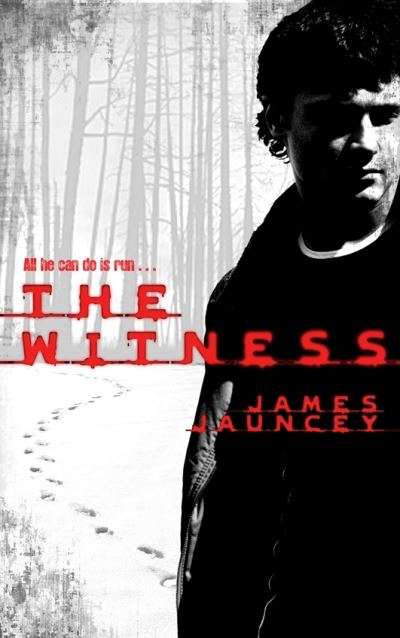
Other writers adopt a more indirect version of urban Scotland particularly through dystopian futuristic fiction. One such example is James Jauncey’s The Witness (2007). One such example is James Jauncey’s The Witness (2007). Set in a near-future Scotland shaped by environmental crisis and political instability, the novel imagines a society in which land reforms, climate change and governmental failures have contributed to widespread social disruption. Against this backdrop, eighteen-year-old John MacNeil becomes the sole witness to the destruction of a small community by state forces. Accompanied by Ninian, the only survivor of the attack, he undertakes a journey across the Cairngorms in an attempt to reunite the boy with his remaining family. As the narrative unfolds, it becomes apparent that Ninian occupies a significant position within the wider political conflict that is dividing the country.
The novel combines elements of dystopian fiction, political thriller and environmental speculation to explore questions of power, resistance and moral responsibility. Through its depiction of conflict between the state and insurgent groups, it invites readers to consider the ethical complexities of political action, including the relationship between ideals, violence and social change. The environmental challenges faced by the characters further reinforce the novel’s concern with the consequences of political and ecological mismanagement. At the same time, the text encourages engagement with civic and political issues, presenting political participation as an important response to social crisis. While the novel ultimately offers a relatively clear resolution to the dilemmas it raises, its treatment of contemporary concerns ensures that it remains a thought-provoking contribution to Scottish young adult fiction.
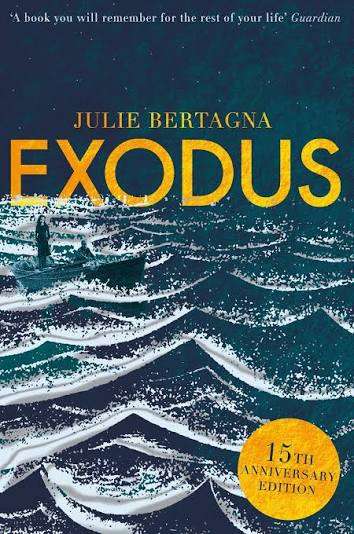
Another apocalyptic extrapolation set in Scotland, one hundred years from the time of the books’ publication and where all public order has broken down, appears in Julie Bertagna’s Exodus trilogy (2002–11). Bertagna is particularly concerned about international environmental issues such as global warming and this provides the impetus for futuristic eco-novels set in the dystopian world of a submerged Glasgow, and contributes to the sub-set of Scottish children’s and young adult fiction deeply critical of contemporary ideologies and world politics:
In the scorching hot summers of the ’30s and ’40s the oceans rose faster than anyone ever expected. All the predictions had been wrong. And all the political agreements that were supposed to prevent global warming had fallen through… Suddenly it was all too late. Great floods struck, all over the world… Governments began to collapse everywhere. Economies crashed and everything that held society together started to fall apart. (Exodus, p. 195)
Bertagna’s is a de-territorialised Scotland deprived of one of its most powerful, traditional and iconic imaginative resources – the landscape – blending into the pluralised, globalised cyberspace of the post-modern age. The ‘virtual’ domain of the ‘cyberwhizz’ allows the erosion of traditional divisions between the local and the global, creating a new zone of ‘glocal’ space, where the language of narration represents the only evidence of a nation conceived in territorial, cultural and ethnic terms. The characters’ names – Partick, Ibrox, Caledon – provide the ‘lost’ locations in Bertagna’s work, and Mara’s resemblance to the ‘face in the stone’ provides a context for the development and re-working of myth and legend inspired by the city’s coat of arms and the story of Glasgow’s foundations.
This small selection of examples of urban literature aimed at the children’s and young adult market should indicate the imaginative and creative ways that Scottish authors are narrating the contemporary life of Scotland and although the picture presented may not always be entirely positive it is thoughtful, challenging and energetic and seems set fair for the future.
(c) The Bottle Imp