Discussions of urban Scottish writing tend, more often than not, to centre on narratives set in Glasgow. This is hardly surprising, since much Scottish fiction from the 1930s onward sprang from the same source. No Mean City (1935) by Alexander McArthur and H. Kingsley-Long was a notorious portrayal of Scotland’s worst ‘area of deprivation’. Its depiction of the impoverishment of the people of the Gorbals led to a famous dispute at the 1962 Edinburgh Writers’ Conference, where Scotland’s most outspoken poet, Hugh McDiarmid, dismissed urban writers as ‘cosmopolitan scum’.1 But even before then, some writers from those same slums, such as Gorbals man Edward Gaitens, had published stories that challenged the myth of Glaswegians unable to escape their circumstances, and did so ‘with bitter, contradictory love of their place and people’.2 After the war a new generation of Glaswegian poets and novelists, such as Archie Hind, William McIlvanney, Alan Sharp and others, wrote against the falsehood that people in poverty were condemned to oblivion, with their fictional ‘heroes’, such as Mat Craig, Jack Laidlaw, and John Moseby, insisting that their working-class backgrounds were meaningful parts of their worlds. Bringing poetry, philosophy, politics and art into their own lives as well as the lives of their characters was an essential part of their aim. The search for a better life, they asserted, included the practice of art in their own culture.3
These writers became known as ‘Proletarian Romantics’, a category defined by critic Alan Bold as ‘tough sensitives’ surviving culturally challenging circumstances.’4 These became the working-class ‘heroes’ who set out to prove their own abilities. At first, Hind was the most forceful of this group, the set-pieces in his novel The Dear Green Place (New Authors, 1966) ‘unsurpassed in recent Scottish fiction’, but, like his protagonist Mat Craig, ‘too good, morally, for the life he is obliged to lead.’5
Urban Scottish literature, however, was never restricted to one place. Greenock and other Central Belt towns, such as Kilmarnock (Graithnock in McIlvanney’s fiction), Paisley, Irvine and Ayr, also deserved better versions in fiction, though they didn’t always get them. Greenock did, however, occupy a distinctive position as the home of the mythical Green Oak, a symbol of endurance which served as inspiration for one writer in particular who was urban to the core.
Alan Sharp, born in Perthshire and adopted at six weeks by a Greenock shipyard family, wrote extensively about his industrial background, and not only in A Green Tree in Gedde (1965), his first novel.6 Between 1962 and 1970 he produced drama for radio and television and three novels which looked closely at his home town. They showed a community crushed into tenements along a shoreline or in rows up its hills, its members eking out their livelihoods while toiling in back-breaking jobs. Sharp’s brother-in-law or ‘good brother’ Peter McDougall (the two men married sisters), shows us this setting in his 1979 drama, Just a Boy’s Game.7 Dancer Dunnichy (Ken Hutchison) toasts bread in a crane control room operated by Jake McQuillen (Frankie Miller) high above a dock. We see the machine’s rusted struts, its battered controls and the open gas fire the men use to toast their bread. These were real cranes in a dilapidated shipyard which, a decade later, had vanished with all the others on the Clyde. Signs of its greatest industry’s imminent destruction were as clear a part of Greenock’s landscape as the hills on either side of the Firth.
In other dramas, MacDougall and Sharp showed how provincial town dwellers sometimes resisted and sometimes worsened their lot. The Long Distance Piano Player (1962),8 Sharp’s first broadcast radio play, is a surreal half-hour drama based on a cruel public spectacle which took place in Greenock.9 An audience watches a man’s suffering during a marathon piano playing-event and gloats over his pain. Poverty and isolation breed indifference to human suffering, Sharp tells us. His next radio drama, We Are the People (1964),10 follows a young man’s return to his home town. On a previous visit, Harry had an affair with his brother’s wife, who is now pregnant with his child. He flirts with another woman, is beaten up by her boyfriend and banished from the town. Violence, betrayal and exile are parts of everyday life in this isolated town. Only football, fighting and sex distract ‘the people’.
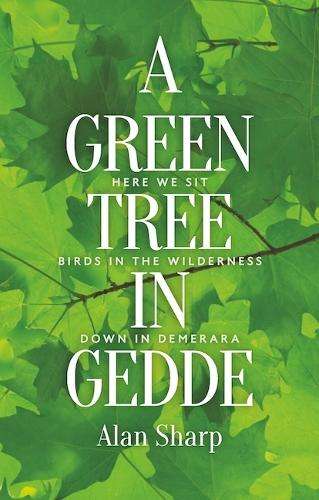
A Green Tree in Gedde (1965), Sharp’s bestselling novel, deserved to win the 1967 Scottish Arts Council Prize despite protests from the more established authors on the short list. But the range and ambition of Sharp’s fictional world was far greater than his competitors’, encompassing not only the urban west of Scotland but other parts of Britain and beyond it, including Manchester, the Midlands, London and Paris. Glasgow, Greenock and their like are mired in provincialism, Sharp shows us, their inhabitants capable, perhaps, of living full lives if only they can ‘go away and come back again’.11 But they cannot. ‘In Greenock, you know, nothing has ever happened nor ever will,’12 says Harry Gibbon, the novel’s most sympathetic character. Gibbon wants to leave home to explore his sexuality, but fails to, although he travels in search of it.
Glasgow, Sharp writes in his epic trilogy, is ‘an inarticulate scrawl saying stony, grimy words …’ where there can be no ‘green eden’ and an illicit love affair is the only way out.13 Sharp’s anti-hero John Moseby, married with a daughter, is no slouch in that respect. In Home and Away (1966),14 a television ‘drama-documentary’ which Sharp wrote and returned to Greenock to help produce, a mother and father argue in a tenement flat about whether their son should stay at home or seek a better life elsewhere. ‘Oor lives are whit they are, but Harry’s isnae. It’s still tae come. There’s nae herm in wantin’ it to be different,’ Mr Bradley pleads. ‘Naw, nae herm in wantin!’, his wife scoffs. In A Knight in Tarnished Armour (1965),15 Sharp’s BBC Wednesday Play filmed partly in Glasgow, the young hero Tom, played by Paul Young, discovers that his dreams of being a private detective, like his heroes in Chandler, Hammett and Ed McBain, are fake, and loses all hope.
Families breaking apart, industries destined to shatter, young lives that find no escape: in all these pieces Sharp shows us that provincial urban hells are worse than city ones, and that ‘life in the provinces’ (as the BBC often termed it) was buried beneath indifference. Sharp left for America and a better life in the early 1970s. The writers who stayed behind followed harder paths. Mat Craig finds only vomit on the streets of his dear green place16 while his creator completed only one full novel. William McIlvanney seemed to lose his way in his later decades. McDougall’s dramas in some ways remained the most beautiful and brutal expressions of the Proletarian Romantics’ work.17 His first televised drama, The Elephant’s Graveyard, originally written as a long poem,18 grew while it was adapted for the screen. From a story of two men’s adventures one day in the hills, it became a dreamlike tale of lyrical emotion and even homoerotic affection. Two unemployed shipyard workers played by Billy Connolly and Jon Morrison spend their day on the hills rather than tell their wives they have lost the last sign of their ‘manliness’, their jobs. For once in Scottish writing, a bolt-hole is not an urban hell but a pastoral heaven. The camera lingers on the men’s shining faces, their glowing affection for each other as they climb and play, their laughter as they run. The love each feels for the other grows through the day until the dream ends.
McDougall’s plays and the other strands of drama intended to provoke and disturb viewers in the single-play anthology series established in the 1960s19 were often opposed by forces which were hostile to a publicly owned body taking the lead in social debates.20 Scottish urban fiction ultimately suffered a similar fate, with later versions of the Proletarian Romantics’ work coming to be considered outdated.21 At the same time it became clear that Scottish women’s writing had been almost entirely overlooked. Soon, women writers were making their own, very different contributions. In her short story collection Night Geometry and the Garscadden Trains, A. L. Kennedy brought new tension and wry humour to the suburbs, while Janice Galloway’s The Trick is to Keep Breathing (1989) changed the landscape of Scottish writing from examinations of place and people to ‘the slow, inward collapse of a world’.22 Galloway’s fictional territory was North Ayrshire; Janet Paisley’s was Falkirk and the Central Belt and brought harsh physicality to its urban settings. Her short story ‘Long Haul’ in the collection Behind the Lines (Third Eye, 1989)23 made the lives of women who travel alone on Britain’s roads flesh and blood reality in perilous quests that outdo men’s. Where male writers had tended to write round sex, these viragos made it the centre of their characters’ existences. ‘I’m clean now,’ the unnamed woman says as she climbs naked back into Mac’s cab.24 Her world is the endless desert of motorways that divide and connect the length of the UK, a wasteland where casual liaisons, random couplings and even time itself are different. (‘He wasn’t going anywhere. It was the road that moved.’)25 A. L. Kennedy’s later work looked at the byways of sex rather than its consummation, but her novella Original Bliss (Vintage, 1998) spread its wings beyond Scotland to Germany and was adapted there as a film, featuring two people so damaged they cannot be intimate with each other, yet still find a way towards ‘Gleissendes Gluck’, or ‘glittering happiness’.26 As Mrs Brindle, Kennedy’s protagonist, checks into a Stuttgart hotel having travelled there away from her abusive husband and towards her prospective psychologist, even the mirror betrays her shy guilt.27 There is nothing in Scottish male urban writing that comes anywhere near the power of these contemporary women writers.
As political and social change affected the Scottish urban experience and feminist and queer critiques raised the stakes, Alan Sharp’s early decision to alter course for Tinseltown seemed to pay off. From 1971 to 2001 he followed a successful career in film in America and other parts of the world, writing screenplays for films and television drama in some of the most exotic locations in the world. For this reason his place in urban Scottish literature should be seen as transnational rather than national, and no less valuable for that. He remains the only Scottish writer, other than Stevenson, whose influences are different from all the rest. Meanwhile, home-based Scottish writers followed different routes: Alasdair Gray with magic realism; Irvine Welsh with gritty subversion (1993); Alan Warner with ‘savage yet serene fiction’28 set in Oban and Spain. All these new layers of work created more complexity in what it meant to be a member of Scotland’s urban literary scene. Sharp played little part in this phase of Scottish writing, producing no new work in Scotland until the mid-1990s, when he reappeared in Glasgow with two new screenplays, both set in Romantic spaces: Rob Roy (1995) in the Highlands, and Burns (2004) in Edinburgh, Greenock and rural Ayrshire. Burns especially, with its twenty-first-century take on ‘The Bard’ as a ‘rock n roll rabble rouser’,29 had the potential to change Scottish literature through its determination to make a ‘warts and all’ portrait of the ‘sexual chaos’ of Burns’s progress through Edinburgh, a vision intended not only as an eighteenth-century drama with a contemporary sensibility, but also as Sharp’s personal testimony. His relationship with Beryl Bainbridge in the 1960s, which had become notorious with her novel Sweet William (1975) and the film of the same name (1980), was only one example of Sharp’s youthful irresponsibility. (His treatment of his second wife, Sally Travers, was worse.)30 Sharp’s Burns, then, was not a period piece, a historical romance or a biopic about a national figure. It was the Greenock writer’s attempt to show the worst of his own behaviour, a depiction completely ‘true’ in the sense that it accurately portrays a man who lives an unmanageable way of life. It is unique in Scottish literature, urban or otherwise.
In The Apple Pickers,24 the last book in Sharp’s trilogy, which was thought lost for decades but has recently been found, Sharp depicts the west coast of Scotland as a funereal place, its tides cycles of loss and mourning.31 Yet he also seems to suggest that the acts of going away and coming back, a central idea throughout his trilogy, regenerates the present. Critic Mario Relich has also pointed out how Sharp, at this late stage of his largest piece of work, seems to adopt the Argentinian novelist Julio Cortazar’s theory of ‘hyper-reality’, where jumping backwards and forwards in time creates new beginnings, as in a game of hopscotch where children jump from box to box.32 Far-fetched though this may seem, Sharp follows this idea in The Apple Pickers, with the end of its last chapters meeting the beginning of the ones before it without a break. Going away may be leaving everything, Sharp seems to say, but coming back is rebirth, a reaffirmation of the present, a cycle of re-creation which makes one small urban settlement in the west of Scotland the world’s navel: the place of creation, the sacred centre, the omphalos, even in its most earthbound form.
The Anti-hero’s Journey: The Work and Life of Alan Sharp by David Manderson is available from Peter Lang.
A new edition of Alan Sharp’s novel A Green Tree in Gedde, edited by Colin McIlroy and Paul Malgrati, is available from the ASL.


End Notes
- Lawrence Nicoll, ‘In Place of Dialectics’, International Journal of Scottish Literature (2009), p. 3.
- Edward Gaitens, ‘Introduction’, Dance of the Apprentices (Canongate, 2001), p. vii.
- ‘… there is a heroism in the shapes and colours, an elemental starkness which attains archetype, a town looking across a river at hills.’ Alan Sharp, dedication, A Green Tree in Gedde (Richard Drew, 1985).
- Alan Bold, Modern Scottish Literature (Longman, 1983), p. 233.
- Bold, p. 238–39.
- Alan Sharp, A Green Tree in Gedde (Richard Drew, 1985).
- Peter McDougall, BBC Play for Today: Just a Boy’s Game, 1979.
- Alan Sharp, The Long Distance Piano Player, Radio 3, September 1962.
- Letter from James Jack to Alan Sharp, 2002 (Alan Sharp papers, Dundee University).
- Alan Sharp, We are the People, BBC Home Service, November 1964.
- Sharp uses the idea of leaving and returning as the means of regeneration throughout his trilogy.
- Reflecting on Greenock as a place ‘out of history’, whose existence is suspended. A Green Tree in Gedde, p. 34.
- Sharp, A Green Tree in Gedde, p. 232.
- Broadcast on BBC2 in August 1966 as part of the Double Image series. The episodes were interlinked plays and documentaries on a similar theme rather than the drama-documentaries of today. Each episode used two directors.
- Sharp’s play uses location shooting and minimal sets to stress the stark realism of the city.
- The Dear Green Place (1966), pp. 254–56.
- David Archibald, The Drouth, The Greenock Industrial and the Greenock Pastoral, Play for Today Volume 2 (BFI), 2024.
- Interview with Peter McDougall.
- The Wednesday Play and Play for Today.
- M. K. MacMurraugh-Kavanagh, ‘The BBC and the Birth of “The Wednesday Play”, 1962-66: institutional containment versus “agitational contemporaneity”’, Historical Journal of Film, Radio and Television (1997), pp. 367–81.
- Ajay Close, ‘Heart of Darkness – Peter McDougall’, Scotland on Sunday (16 May 1993).
- ‘Reading Matters: The Trick is to Keep Breathing’ (Vintage, 1999).
- ‘Long Haul’, Behind the Lines (Third Eye), pp. 9–18.
- Ibid., p. 15.
- Ibid., p. 18.
- ‘God the Patient, Jealous Lover: the Jealous, Patient Love’, Original Bliss (Vintage, 1989), p. 311.
- ‘The mirror smiled and then looked away’, Original Bliss (Vintage, 1989), p. 197.
- ‘Morvern Callar by Alan Warner’, Kirkus Reviews (1997): https://www.kirkusreviews.com/book-reviews/alan-warner/morvern-callar/
- David Manderson, ‘Promiscuous Sympathies: Alan Sharp and Robert Burns’, Burns Chronicle, 134.2 (September 2025), pp. 148–66.
- Letter from Alan Sharp to Ethel Foote, 15 December 1963, Dundee archive.
- In his letter to the student Audrey Miller (1985–86), Sharp writes of the map of Greenock he pinned to the wall of his bedsit, on which he drew an image of a human figure with her legs ‘splayed round Lyle Hill’. In The Apple Pickers he describes the cries of the ferrymen on the Clyde ships and the jellyfish that ‘pulsed’ in the water alongside them. His images are consistent with his vision of the west coast of Scotland as the origin of all birth and death.
- Relich suggests that Sharp’s alternative way of reading his novel paralleled Contazar’s although Sharp could not have read Cortazar at the time, Hopscotch being published a year before Sharp’s first novel.