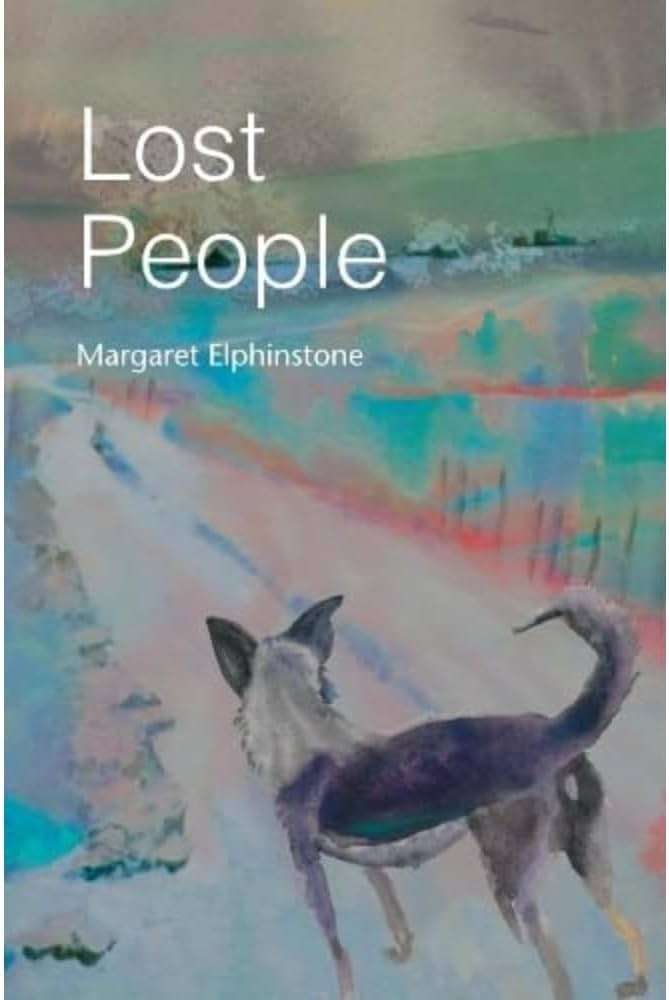
This new novel by Margaret Elphinstone, former Professor of Creative Writing at Strathclyde, is, like much of her other work, ‘mostly historical and about people living on “the edge”’1, as she describes it herself, which can also seem similar to science fiction. Its appearance marks her return to long form story-telling after a period of fifteen years. The pause certainly seems to have encouraged her to produce new material. Her website is full of new poems and stories, reflections on her novels, details of writing groups, literary events, news of nominations (with Lost People shortlisted for the 2024 Saltire Award) and her reflections on her early work.
Margaret Elphinstone was my PhD supervisor from 2002–06, and during that time I got to know her careful and meticulous way of encouraging her students, myself included, towards their best work. She undoubtedly developed this sensitive approach through the writing of the eight novels she had published up to that time (Lost People is ninth on that list). These early works, which include The Incomer (1987), A Sparrow’s Flight (1989), and Islanders (1984), are all ways of discovering ‘what is worth preserving (of our existing culture), and what will randomly find its way into a future in which almost all our… culture has been swept away.’2 Alison Phipps, Head of the UNESCO Asylum Panel, writes in her introduction to A Sparrow’s Flight that Elphinstone’s fiction reflects the unstable worlds in which we find ourselves, and ‘tilts the world, helping us view the contemporary through a different lens.’3 The lens in the case of Elphinstone’s second novel is the past, Phipps suggests, but in Lost People, tilted in another way, what seems revealed is a dystopia which can only be our future.
At the beginning of her writing career Elphinstone was involved with political campaigns such as Greenham Common and the Women’s Movement, but she was never simply a follower of causes, and also wrote two gardening books as expressions of her interest in the acts of planting and regeneration. Kathleen Jamie’s identification of Lost People as ‘a story of trauma’ also seems accurate. In the novel, the world has been devastated by war, holocaust or some other disaster. Families no longer exist. Orphans find their way to the place called Sanctuary without knowing who they are or how they came there. A mother-figure leaves a child there for a reason the child doesn’t understand. She knows nothing about herself except that her name is ’Rue’. She is not even certain if she is a girl or a boy, although that does not matter, as one Sister points out. She needs food, warmth and shelter, and survives by hiding during the daytime, picking up food-scraps at dusk and wrapping herself in rags that seem ‘old and kind’ to sleep in at night. Noise hits her like a hammer blow. She must run and wait ‘to hide her trembling deep inside’. The rest of her memory is empty, although she learns of a War Zone outside where people were massacred, their bodies left unburied. It seems likely that the child’s parents were among them.
Rue is emotionally cauterised, like all the Orphans. They are alone, unprotected and the victims of circumstances they can never hope to overcome. But at least this young person has been given a task. She takes care of the knot garden, a place where she can watch, work and learn.
This geometrical maze of herbs and boxed bushes, always growing and changing and supplying the Sanctuary with tastes, scents and herbal remedies, stands in the Sanctuary’s first quadrangle. The idea of this kind of cultivated space was what inspired the author when a remark by a friend triggered ‘an entire world’ in her imagination. That world is being reduced to its barest needs. Native species of birds and butterflies are vanishing as global violence and climate change accelerate. What is worth preserving of the past, and what might find its way into our future? Not much, the answer seems. But the knot garden brings a new form of creativity. The original version, historians tell us, had its branches woven into knot-shapes to symbolise unity, order and infinity,4 the qualities this world has lost. A knot can also mean a pact or a promise, an agreement to bring people together and begin to knit the fabric of a society again, and it is here that we can see Elphinstone’s intention take shape. The Lost People may live in a future without hope but the knot garden answers their predicament. Despite the destruction, a connection with the living planet remains, and regeneration is happening, without human agency. Hope lies where the planet sustains itself. All that is needed is patience, and careful tending: ‘Thyme is delicate. You take each little stalk and rub the leaves off backwards. Then pinch out the tuft at the top between your fingernails’.
Lost People is published by Wild Goose Publications


End Notes
- Author Profile, margaretelphinstone.co.uk
- A Sparrow’s Flight, margaretelphinstone.co.uk
- Alison Phipps, ‘Introduction’, A Sparrow’s Flight (Kennedy and Boyd, 2007), p. viii.
- What is a Knot Garden, Garden Ninja.